Marquee Moon
Songs of the Sublime

Back in the seventies, nothing was more hip than the album this song took its name from. I was tempted, but the meagre earnings from a Saturday job cleaning a bakery left no room for error.
Television were among the pioneers of the so-called new wave, evolving punk's confrontational spirit into something more musically ambitious. The reviews were all ecstatic, but would I actually like it? That was another question.
To hedge against buyer’s remorse, I also picked up something sturdier: a reassuringly familiar slab of British old school metal, complete with occult pretensions, which will remain unnamed (for my sake as much as theirs).
One listen was all it took.
There, in my bedroom at my parents’ house, I experienced one of the most powerful musical awakenings of my life.
‘I remember / Ooh, how the darkness doubled
I recall / Lightning struck itself
I was listening / Listening to the rain
I was hearing / Hearing something else’
Marquee Moon felt like a parallel universe – one where rock music had been rebuilt from the ground up using Baudelaire’s poetry, film noir atmospherics and a clean, fluent, sensual approach to guitar.
It couldn't have been more different from my other purchase, which has long since disappeared into the mists of memory.1
Marquee Moon was soon hailed by critics as a musical landmark, even if American record buyers were slow to catch on. However, in Britain, its edgy reinvention of rock found more receptive ears. Not least mine.
The title track – last on side one – was at the heart of it.
Unlike other entries in this Songs of the Sublime series, Marquee Moon is less a composition than a recording. It’s a one-off. The lead guitar lines – and especially Verlaine’s epic solo – carry much of the musical weight, while the crisp, varied drum patterns and metronomic bass pull everything together.
Although recorded in a studio, the sound is unmistakeably live. These songs had been honed on stage long before the tape started rolling, and it shows. Listen to the opening of the second verse, where the bass and drums briefly carry the song alone. There's so much confidence in how they lock together, each musician instinctively leaving space for the other.
Verlaine’s unusual, sometimes grating singing style took some getting used to. But after repeat listens, that same unorthodox approach opened up new melodic possibilities – jagged shards of unexpected melody that sounded fresh, urban and contemporary. Everything that the new wave had promised.
Meanwhile, all that nocturnal lyrical imagery conjured visions of shadowy loft apartments squatting beneath New York’s vaunting nightlights, where groups of earnest young people would hang out together until dawn.
‘I spoke to a man down by the track / And I asked him how he don’t go mad’
Maybe the whole thing is about recalling a dream. Or a series of dreams. This is a song that you feel long before you understand it.
My theory about the song’s title
For years, the title remained an enigma. Then, on my first visit to New York (where the album was recorded), I had an experience that made me wonder whether I'd finally stumbled upon my own explanation.
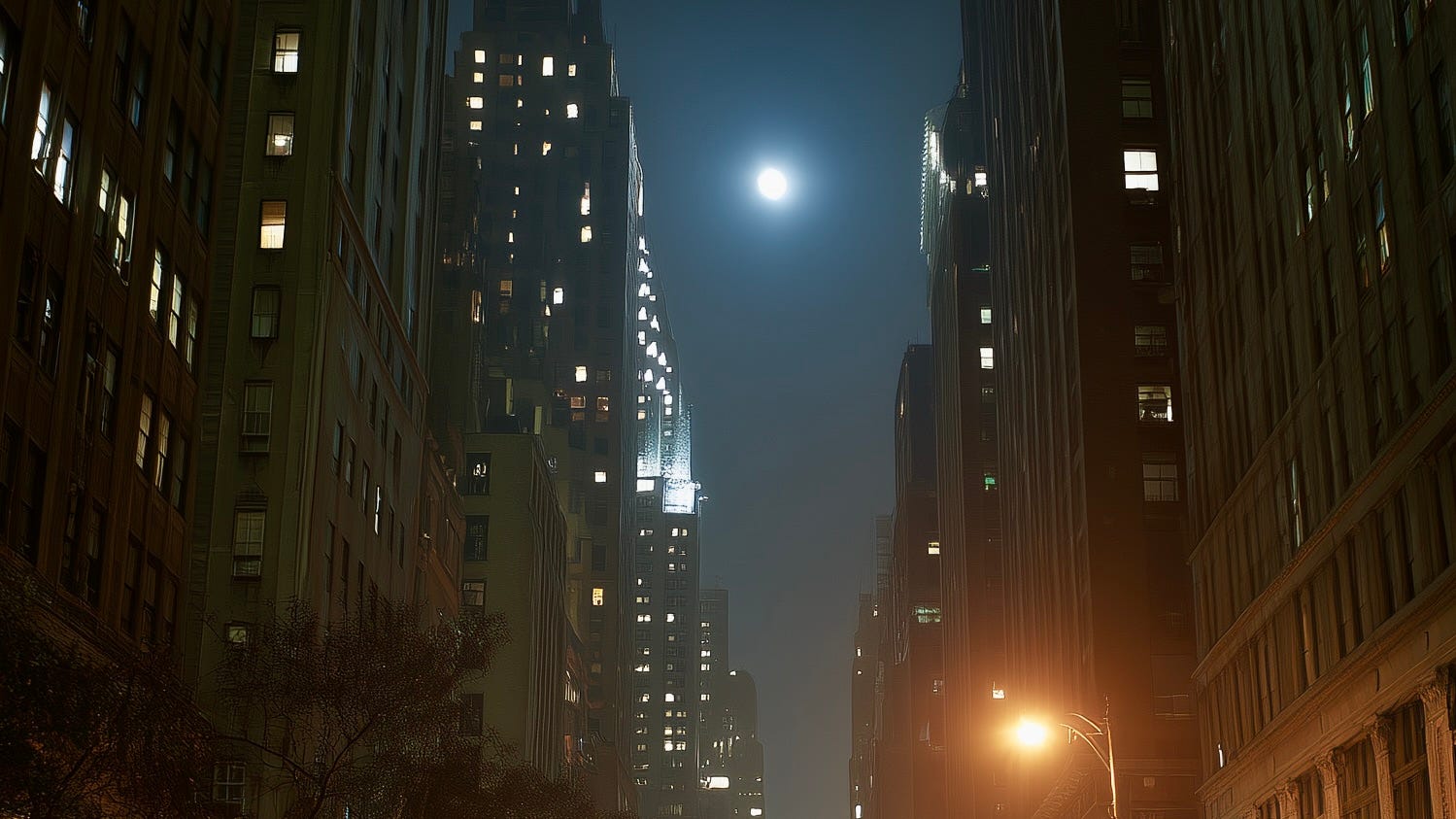
Returning on the Staten Island Ferry, Manhattan looked oddly miniature, as though the skyscrapers could be held in my hand.
Later I realised this was simply my brain struggling to interpret a landscape unlike any it had encountered before. In a city of such extraordinary vertical scale, the natural world seemed reduced to little more than a narrow strip of sky.
So, at night, looking up from those streets, the moon no longer felt part of nature but part of the city itself, framed by the buildings like a light suspended above a theatre.
Perhaps Marquee Moon is not so much a mystery as an exploration of mystery. The ending – where the song stops before reprising the opening verse—leaves us exactly where we began, only somehow changed.
Footnotes
1. It was formulaic, muddily produced and obsessed with being louder, faster and heavier than the competition.
If this kind of reading resonates with you, there’s plenty more to come.
Brendan Staunton writes about those rare songs that illuminate the unseen currents running through life, love and the human condition.
Some of those ideas have a habit of finding their way into music.
Bottle of Pop is one place they show up.